Showing posts with label Mazda. Show all posts

Thursday, February 24, 2011

Mazda MX-5 Kendo

Mazda has now built over 900,000 examples of its MX-5 / Miata / Eunos Roadster.


Sometimes it feels like a large proportion of those have been special editions, so there are no prizes for guessing how Mazda has decided to mark that production milestone. Yes, it has cobbled together yet another special edition.


This one is called the ‘Kendo Special Edition’, named after the modern Japanese martial art. On sale in the UK from the beginning of March, buyers will be able to choose from either the £19,255 MX-5 1.8i Kendo soft-top or the £22,320 Mazda MX-5 2.0i Kendo roadster coupe.


The formula used is tried and tested: Paint the car a different colour, stick some fancy trim on the seats, add a few options.


In the case of the Kendo - which is based on the current SE models - this means Sparkling Black or Dolphin Grey mica finishes for the bodywork, while the interior gets Stone Leather upholstery.


Also included are unique 17” alloy wheels, cruise control, Bluetooth telephone connectivity and a Bose audio system. Finishing things off are heated seats, brushed aluminium trim, front fog lights, aluminium pedals, floor mats and special badges.


Related post:

Mazda MX-5 Miyako

Monday, January 3, 2011

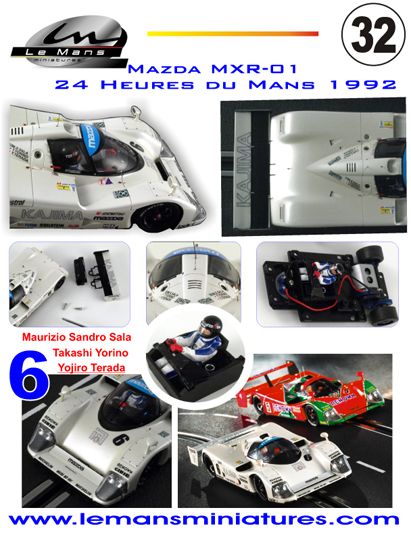
LeMans Miniatures Mazda MXR-01

New LeMans Miniatures Mazda MXR-01 info.

Sunday, January 2, 2011

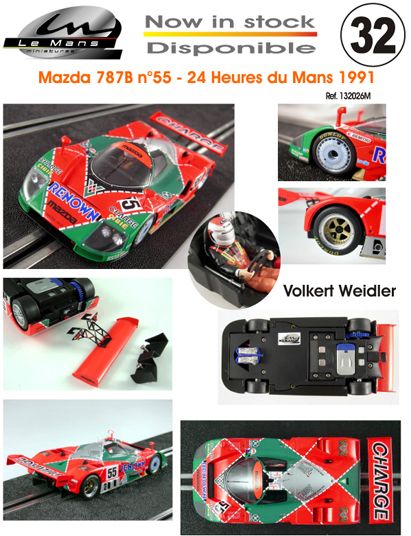
Mazda Renown-LeMans Miniatures in stock in NA

The Mazda 787B "Renown" info sheet.

Wednesday, December 1, 2010

BBR gives MX-5 235 bhp

The Mazda MX-5 is a great little sports car, but the most powerful version currently available features a 2.0 litre engine with a fairly modest 158 bhp (118 kW / 160 PS).


For those who think that that’s not enough, tuner BBR has got together with Cosworth Engineering to provide a fix.


Their solution is to attach a fourth generation Eaton MP62 supercharger, which lifts power by almost 50% to 235 bhp (175 kW / 238 PS), while torque rises from 188 Nm (138 lb/ft) to 257 Nm (190 lb/ft). That puts the BBR-Cosworth MX-5 right on a par with competitors such as the £33,870 Mercedes-Benz SLK 300.


However, the conversion consists of more than just the supercharger. To help the engine breathe better, a Cosworth inlet manifold housing is fitted, together with high-flow calibrated injectors, air box and air filter.


Managing everything is a BBR Auxiliary Interceptor 2010 engine control unit, which has 3-D mapping and a MAP sensor. An air to water intercooler is also included in the package, and competition-grade hoses and fixings are used throughout.


The finishing touches are the BBR-Cosworth identification badges, which are the only external clue to the under-bonnet transformation.


The BBR-Cosworth Mazda MX-5 supercharger upgrade is priced at £4,995.00, including installation by BBR. Kits will also be made available for DIY fitting.

Friday, October 15, 2010

Mazda Furai Concept, 2008

Mazda Furai Concept, 2008


Furai is the sort of car that could only come from a company that incorporates the "Soul of a Sports Car" into everything it builds, but with an eye toward the future and the environment through the use of renewable fuels. Driving toward sustainability, Furai was initially tuned to operate on 100 percent ethanol fuel, the first time a racing three-rotor rotary engine has been fueled by ethanol. Research continues in earnest with partner BP into other renewable and future fuels, including ethanol gasoline blends like E10.

On any given weekend, there are more Mazdas and Mazda-powered cars road-raced in North America than any other brand of car. This is because every Mazda sedan, coupe and sports car really is developed with the highest possible dose of the company's trademark Zoom- Zoom - truly the Emotion of Motion.

However, Zoom-Zoom is more than simply vehicle performance. The look and style that is Zoom-Zoom can best be seen in previous NAGARE-based efforts, including the Mazda Nagare concept that debuted at Los Angeles in 2006; Mazda Ryuga, which was first shown a year ago in Detroit.

Instead of mimicking racecar components and design elements in a road car - the strategy preferred by supercar manufacturers - the "Mazda way" was to begin this project with the real McCoy: a Courage C65 chassis that earned its stripes during two seasons of LMP-2 endurance racing in the American Le Mans Series (ALMS). This sports car was successfully campaigned under the MAZDASPEED Motorsports Development banner by B-K Motorsports during the 2005 and 2006 seasons. Drivers Jamie Bach, Guy Cosmo, Elliott Forbes-Robinson, and Raphael Matos piloted the car to one victory and a total of nine podium finishes in 15 ALMS events. B-K finished third in championship standings both years; Bach and Cosmo were co- Rookies of the Year in 2005.
The Furai concept serves as a turning point in the Nagare developmental process. While the four previous concept cars explored different ways to express Mazda's emerging design philosophy and to explore an aesthetic, this one is all about function - every last texture and detail serves some functional purpose. In essence, the Furai creative process boiled down to guiding air over and through the body in fruitful ways. To prove that this concept goes far beyond static aerodynamic analysis, Mazda's design, motorsports and R&D teams worked together to construct Furai as a 180-mph rolling laboratory to demonstrate its functional capabilities on demand.

"The basic proportions of contemporary race cars are every designer's dream," enthused von Holzhausen. "Furai is less than 40-inches high but nearly 80-inches wide."

While Furai strikes an incredibly strong presence, the real beauty of the project - and it's most valuable asset as a real-world test-bed - is in the details that von Holzhausen and his team incorporated:
  • The body surface provides ample opportunity to feature core design elements such as aggressive headlamps and Mazda's trademark five-point grille.
  • The headlamp trim pieces function as guide frames to help cancel aerodynamic lift.
  • High-pressure zones just above the front wheels are relieved to serve the same end.
  • The air flow package takes air moving under the front of the car and guides it inside the body to the engine-cooling radiators.
  • Nagare textures incorporated in the side surfaces feed air to the rear brakes, the oil cooler and the transmission cooler.
  • An under-car diffuser that begins rising aft of the cockpit helps draw the volume of air flowing through the heat exchangers and engine bay out the rear.
The Mazda design and R&D teams worked closely with Swift Engineering to refine the aerodynamic characteristics, assuring that Furai remains glued to the ground at high speeds. Through its existing relationship with Swift Engineering, forged through development of the Mazda/Cosworth-powered Champ Car Atlantic chassis, the team used complex Computational Fluid Dynamics (CFD) software to tune various Nagare design elements to function at a high degree of efficiency. Drag, downforce, lift and overall esthetics were all key considerations.

Sourced straight from the race track, the Courage carbon-composite tub is essentially intact under the new Furai body, including the right-side driver's seat. Instead of the stark interior typical of race cars though, this cockpit is finished with more comfortable but still highly functional surfaces. An electronic display screen and shift paddles are built into the steering wheel.

In the chassis' original racing configuration, the passenger seat is filled with electronic gear, so those components were relocated elsewhere to provide adequate space for two occupants. The greenhouse is somewhat wider than the original cockpit to provide adequate head and shoulder room and suitable outward visibility. Doors attached with butterfly hinges provide a very efficient means of entering the cockpit. In this instance, the design team followed an approach that has proven very effective during years of endurance racing.

Furai not only probes future design possibilities, it also ventures ahead with alternative renewable fuels. Consistent with Mazda's recently announced "Sustainable Zoom-Zoom" initiatives, Furai's three-rotor powerplant has been tuned to run powerfully on ethanol (ethyl alcohol) and ethanol gasoline blends. There are exciting advances being made in renewable fuels, from current blends like E10 (10% ethanol and 90% gasoline) with research ongoing in making Ethanol from cellulostic materials, to future renewable gasoline components like Butanol, a higher order alcohol which is fungible with gasoline. The addition of these renewable components improves Mazda's understanding of how these fuels work with the company's technology. and reduces the consumption of fossil hydrocarbons and the emission of harmful greenhouse gasses.

Through the BP partnership, Furai has been specially tuned to operate on renewable fuels. BP engineers continue to work to optimize other fuels, including investigating new future renewable fuel components. This is Mazda's first experience with ethanol fuel in a three-rotor racing engine, and the results have been convincing that, once again, the Mazda rotary engine is unique in its ability to run well on multiple fuels.

Ethanol is derived from grains such as corn and wheat or soybeans. Corn, the predominant feedstock, is converted to ethanol in either a dry or wet milling process. Future advances for renewable gasoline components include utilizing a wide variety of cellulosic biomass feedstocks, including agricultural plant wastes (corn stover, cereal straws, sugarcane bagasse), plant wastes from industrial processes (sawdust, paper pulp) and energy crops grown specifically for fuel production, such as switchgrass.

Furai has shown the Mazda team is the real value:
  • Racing Beat worked tirelessly to develop the world's only ethanol powered threerotor rotary engine.
  • Mother's Waxes and Polishes supplies an extensive range of waxes, polishes, and cleaners to keep the car looking its best at all times.
  • Together with Liferacing, AER developed a six-speed paddle-shift mechanism.
  • Brembo worked with the Mazda team to ensure the brakes were as effective on Furai as they were in competition
  • Sachs and Eibach worked together to bring an aggressive, but steetable, shock and spring package.
  • Nippon Paint provided the amazing three-feet-deep paintwork.
  • Castrol supplies all the high-performance lubricants.
  • Mazda's 2006 and 2007 ALMS tire development partner Kumho created the special tread patterns necessary for Furai's tires.
  • Wheels are from partner BBS, and are 14-spoke, centerlock aluminum.
  • Seatbelts come from Sparco Motor Sports.

Mazda Ryuga Concept, 2007

Mazda Ryuga Concept, 2007


The large wheels placed at the far corners of Ryuga's exterior lend a highly stable, balanced stance. The aggressive wedge shape imparts motion even when this sports coupe is parked. Volumes that are small in front, larger at the rear, wrap around and over the wheels to give the exterior tension and direction.

Conducting a guided tour of the exterior, Nakamuta points out several key features:
  • Ryuga's side surfaces were inspired by karesansui (Japanese dry gardens). The carefully raked pebbles in these garden s represent peaceful ripples caused by a breeze over a pool of water. The karesansui's man-made image of natural flow is represented in the Ryuga's surface texture to express simplicity and refinement.
  • The headlamp shape resembles the flow of morning dew dropping from bamboo leaves. Advanced LED and fluorescent tube technology will enable such a striking design to be used on a production vehicle in the foreseeable future.
  • To impart motion, the 21-inch wheel spokes - different on the left and right sides - are slightly twisted as if they're delivering torque. To convey the feeling of gas turbine blades, the trailing edges of the wheel spokes are accented with a tinge of body color.
  • Flowing lava inspired both Ryuga's exterior hue and the tail lamp design. Depending on the incident light, Ryuga's surface appears to be shades of yellow, red, and blue, exactly like molten, flowing lava. Notes van den Acker: "The hot red finish goes straight to your heart."
  • The roof molding tightens up the flowing cabin and gives an accent to the body styling as well. Cameras located at the forward end of each molding convey rear views to a center cockpit display screen. Turn signals are also integrated into these protruding accents.
  • Reflecting its Japanese origin, Ryuga is both simple and complex. While the dominant flow theme is simple, the details - such as the side surfaces and the wheels - are intricate. Solidity and fluidity live here together, in harmony.
FLOW THROUGH INTERIOR
The Ryuga is significantly shorter and lower than today's four-passenger RX-8 sports car, it too accommodates four passengers in roomy comfort. A relatively long (110.2-inch) wheelbase and two large gull-wing doors provide a wide-open invitation to the interior.
The doors rise to expose the interior of Ryuga and allow easy slide-in access, the passengers are presented with the fusion of a cockpit - designed to maximize the emotional connection between the car and driver - with the social atmosphere of the rear passenger space, where lounge-like comfort is ensured through expansive space and Nagare-inspired design.

The front bucket seats provide ample lateral support for energetic driving with the shape of the seats creating an impression of movement which is further emphasized by the patterns in the material.
The experimental 'floating' center cluster allows a high level of interface between the driver and the multi-function touch panel without having to take one's eyes off the road ahead. Information necessary for safe and dynamic driving is available to the driver with RPM and speed (which is shown in both analog and digital format s ) being displayed on the same axis.

Flowing upwards, the center cluster dynamically penetrates the front information panel which reflects Zoom-Zoom futuristic and sporty design craftsmanship, as well as an integrated interface between man and machine. Elongated pods give the cockpit depth while bringing information closer to the driver's eyes. An open-top steering wheel provides enhanced sight lines to the instruments and the road ahead .

THE DRIVING PERFORMANCE - ENVIRONMENT AND SAFETY TECHNOLOGIES TO SUPPORT ZOOM-ZOOM

The part of the initiatives, an E85/Gasoline FLEX FUEL engine which runs on sustainable bio fuel could be used in Ryuga. This engine delivers torque and power, balancing driving and environmental performance. Other important features that will support safe driving are the Charge-Coupled Device (CCD) cameras installed for the rear monitoring system and the blind-spot monitoring system. These help ensure safe driving while changing lanes and allow easy identification of potential obstacles. Mazda is working on various technologies to deliver Zoom-Zoom driving in the future, including earth-friendly environmental technologies and people-friendly safety technologies.

To ensure the car provides a Zoom-Zoom driving experience, which is the basis behind all the other features, an open top steering wheel is employed with highly sensitive settings to respond to the driver's smallest input. The car also features steer-by-wire technology and gauges that deliver superbly clear information to the driver. The dramatic wheels with TOYO PROXES 245/35R-21 tires complete the driving experience, and the sophisticated original tread pattern perfectly suits the Ryuga's design concept.

Monday, September 13, 2010

2010 Mazda Sport Cars Coupe Shinari Concept Car

Mazda launched the 2010 Shinari sports cars coupe at the Paris Motor Show in early October, a four door concept car that shows the new design. This design as well as to replace the Nagare design. Mazda Shinari Concept represents the profound connection of driver and machine and the beginning of Mazda's latest design theme 'KODO-Soul in Motion'. Shinari exhibits a functional aesthetic that will continue to evolve as Mazda continues to define its next generation of vehicles.
2010 Mazda Sport Cars Coupe Shinari Concept Car
The development of the Shinari Concept was actually a collaboration between three of Mazda’s design centers in Japan, Germany and the United States. Mazda also said it is working to improve the quality level of its interiors for future vehicles. With 2010 Mazda Sport Cars Coupe Shinari Concept Car as the first step, Ikuo Maeda, general manager of Mazda's design division, aims to create original Mazda designs that will be recognized around the world. He summarizes his resolve in the following words:
"My goal is to create designs that people can point to proudly and say, 'This is a Mazda design'. There is no need for Mazda to build cars for people who are only concerned with 'style' and 'trends'. Whether working on sports cars or compact cars, I have always worked to create designs that evoke an emotional response in people and I hope to keep doing the same as I remain fully committed to develop designs for people who love and admire cars. It is my personal belief that the only way to create designs that fundamentally connect with people and to create designs they love, is if the people creating them are absolutely passionate about cars and are willing to make that passion a firm policy for design expression.
The Mazda Shinari is a pure design concept model of a four-door, four-seater sport cars coupe which perfectly expresses the 'KODO - Soul of Motion' design theme in a graceful and carefree form. All of Mazda Shinari Concept's body surfaces appear as if constantly undergoing transformation. There is no static shape to be found, as if the car is in perpetual motion. For instance the subtle control of the angle of the upper surface of the side sill, from the front to the rear, results in a form that suggests a flash of speed along the body of the car. Aerodynamic performance was a major priority for Mazda Shinari Concept, and the centre of the lower sections - on both the front and rear bumpers - are designed to optimize the flow of air along the underbody of the car.
2010 Mazda Sport Cars Coupe Shinari Concept Car 
The principle of 'dedicated driving ergonomics' is further reflected in the car's next generation Human Machine Interface (HMI). The availability of smaller electronic components has allowed Mazda Shinari Concept's designers to create a floating HMI three-dimensional display; a design element that represents the very latest HMI technology . The system offers three distinct modes: 'Business, Pleasure and Sport'.
Yasushi Nakamuta, the chief designer who led the design of the third generation Mazda MX-5, was the first to begin the ideation of the Mazda Shinari Concept: "The challenge for us was to create an innovative new expression for energetic and powerful movement; something that we had never attempted before. We began by developing the design around the image of a predator, as it strikes at its prey, or the stabbing movement in kendo, Japanese fencing, to express the instant where accumulated force is released.
Ikuo Maeda say, "Further, I consider it vitally important to have an awareness of Japanese originality in designing cars for Mazda. This is not merely about incorporating traditional Japanese elements into car design. I believe in reflecting the Japanese spirit in car designs as part of a subconscious practice. So, while I consider where this may lead in the future, my plan is to create cars that will be instantly recognizable as a Mazda, even when viewed at a distance. My ultimate goal is to create a brand presence that car lovers around the world recognize as representing both Mazda originality and Japanese originality. Future Mazda's will move people physically and emotionally - this is 'KODO - Soul of Motion'."

2010 Mazda Sport Cars Coupe Shinari Concept Car 

Tuesday, August 31, 2010

Mazda Shinari Concept debuts new face of the brand in style

Mazda Shinari Concept

When Mazda invited us to Milan to see its new concept car, we knew it must be something important. Normally concept cars get their 15 minutes of fame at an auto show, and then it's off to the next press conference to see what the following automaker will introduce. Not so with Mazda's latest styling endeavor. The Japanese automaker wanted our full and undivided attention, with the center of international design and fashion in Italy as a fitting backdrop.

The Shinari concept, which roughly translates to "resistance to being bent," will serve as a the basis for Mazda's new design language, and many of the styling cues will make it to future production vehicles. That means that the Shinari will essentially affect the design of every vehicle coming from the Japanese automaker for the next several years. An important car for Mazda? You bet.

The Shinari was officially unveiled earlier today, and we spent several hours talking with Mazda's artists about the design and how it will affect the automaker's forthcoming vehicles.

The creation of the Shinari Concept starts with Ikuo Maeda, Mazda's global head of design. Maeda was the chief designer of the RX-8 and the Mazda2 and has been with the company for nearly 30 years, but his connection with the brand goes back even further than that. His father, Matasaburo Maeda, headed the design of the first generation RX-7 back in the 1970s. Mazda runs in the Maeda family's blood and there's no one more qualified to define the look of Mazda's next generation vehicles.

While Maeda has had an influence on Mazda design in the past, 2010 is the first year in which he's had full control. The Shinari Concept represents the first styling concept under his new design theme, KODO, which replaces the controversial Nagare them from the past several years. While the Nagare-styled cars were represented by wavy, flowing lines, a trait that looked great on concepts but was tough to implement on production cars (see Mazda3), KODO is more of an organic style that still takes cues from the natural world, but in a much more solidified and powerful sense. Maeda describes KODO as form with a soul, or bringing form to life, with the three key terms defining the theme being speed, tension and alluring. "There are few products of industrial design that can be compared to living entities which convey energetic motion and which invite affection," he says. "It is this intrinsically emotional appeal of the car that I wish to express when creating Mazda cars."


While Maeda created the theme for the new stylistic direction, the development of the Shinari Concept was actually a collaboration between three of Mazda's design centers in Japan, Germany and the United States. The goal was to make the exterior a product of Japan, while the interior was left to the automaker's Irvine studio. However, each team had input on the final product.

Looking at the exterior, it's easy to tell that the Shinari shares little in common with Mazda's recent designs, although like almost every sedan built today, it has similarities to vehicles from other brands. It's almost as if the Aston Martin Rapide and a Mazda RX-8 cued up some Barry White, enjoyed a romantic evening and the Shinari came out nine months later. That's obviously a compliment, as the Rapide is a stunningly beautiful car and the RX-8 – even this far into its lifecycle – is still a looker. However, the Shinari has a much more complicated design, with more intersecting lines and a surface area that's constantly moving and changing depending on the lighting.


Those who dislike the smiling face of the current Mazda lineup will be glad to know it won't be a feature in future models (Huzzah! – Ed.). The Shinari front end features a "signature wing" that will become a new styling cue for the brand. The wing is formed by a thin aluminum band that starts from the bottom of the grille and goes out and up through the headlamps and continues with a bold fender line moving out onto the sides.

The most impressive aspect of the exterior design was the devotion to the theme in nearly every inch of the concept. The various aluminum pieces found on the exterior have a "twisted tension", and even the slots in the disc brakes follow the same theme. In addition, items like the headlights were designed to have a more natural look and fashioned to mimic the iris of an animal's eye. We're also big fans of the stylish rear view cameras in place of the standard mirrors as well as the trick door handles (although "button" might be a more appropriate description) that require only a simple press to open.


While the exterior is certainly a departure from previous designs, the interior is perhaps the most surprising aspect of the Shinari. Easily the most attractive and stylish interior we've seen in a Mazda (concept or not), it's swathed in authentic aluminum trim, leather-covered surfaces and double stitching at nearly every turn and twist. We're again drawn to the Aston Martin Rapide comparison, especially with the design of the deep rear bucket seats. The gauges, modeled after popular watch designs, up the class quotient and the massive glass roof helps make the interior feel open and airy.

We know many of these elements won't make it into a production car, but Mazda's North American director of design, Derek Jenkins, who oversaw the development of the Shinari's interior, says it's Mazda's goal to add sophistication to future models. "Mazda is really an aspirational type of brand," he says. "Even though we are a mainstream brand we have a customer that wants a little bit more. We monitor premium segments, we monitor premium trends, and the question is ultimately how can get some of that feeling into a more affordable vehicle. We think our customer wants a little bit more sophistication."


One thing that can definitely be seen in future Mazda interiors is a driver-focused cockpit. A close look at the Shinari's interior reveals an asymmetric design that snugly surrounds the driver's seat while leaving the passenger seat more open and relaxed. Jenkins says this will be theme of upcoming Mazda vehicles and help set the brand apart.

Finally, the Shinari also features quite a bit of technology that looks forward to the new applications of driver-automobile interactions. The Human Machine Interface (HMI) is split up into three modes: Business, Pleasure and Sport. Potential uses range from looking up bios of a business contact before a meeting to a rally-style co-pilot feature that could alert the driver of the characteristics of upcoming turns. It's nothing too far-fetched given the current levels of technology, and we wouldn't be surprised to see some of it implemented in the near future.


But more than the tech and the attention to detail, it's the Shinari's overall cohesion that impresses the most. Unlike other pie-in-the-sky concepts, the Sinari is a smart, well executed styling exercise that should be a solid design platform for future models. The muscular lines should translate well into a production car, and customers will always appreciate a more sophisticated interior. And what about the potential of a four-door sports coupe like the Shinari making it to production? Mazda wouldn't tell us whether one is in the works, but they did mention that the "business side of it" was considered when the Shinari was under development. That definitely means there's a chance, and we sure like the sound of a Mazda RX-9.

Friday, July 23, 2010

Rumor: Mazda Working On Next Generation, Forced-Induction RX-7

1992 Mazda RX-7 Turbo


If you’re an automotive journalist who’s also a gear head, it’s easy to despair over all the news coming from manufacturer’s these days. Like them or not, we’re about to be force fed a steady diet of hybrid automobiles in every shape, size and configuration. Don’t get me wrong, I’m not anti-hybrid; they have their place in commuter cars. I AM anti-hybrid when it comes to building an enthusiast oriented sport sedan. I don’t want the added weight, complexity or cost of a hybrid drivetrain, especially when the increase in fuel mileage is only 10 to 20 percent.

So with that in mind, I really hope the latest rumor about Mazda, as reported on Autoevolution, is true. Sources at Mazda report work on a turbocharged variant of their Renesis rotary motor, for use in a new sports coupe dubbed the RX 9. The best news is that we’ll see the car as soon as 2013, and it appears that Mazda is taking it in the pure-sports-car direction of the last generation RX-7 Turbo.

There are some significant hurdles to overcome, including lowering emissions from the Renesis motor (now out of production in the EU because of stricter environmental regulations) and boosting the Renesis’ dismal fuel economy. Mazda has tricks up their sleeve to address these failings, but they’re not providing many details. An inside source reveals that Mazda is working on electric turbocharging as a way to reduce emissions, which will need to meet even stricter standards in the EU by 2014.