Showing posts with label Fly. Show all posts

Wednesday, January 19, 2011

The Dirty Dozen: Rally Car Showdown

Rally racing is a difficult sport to follow in North America. It doesn't receive nearly the television air time that it deserves which tends to keep it out of the public eye. Still, I've managed to end up with a few rally cars in my collection. Thanks to the popularity of this sport in Europe – home base to most slot car manufacturers' head offices – slot car racers have quite a few interesting subjects to draw upon. Recently, the club at Mini Grid in Toronto started a bi-monthly series for rally cars so I needed to find the most effective tool for racing there. To do this I've reached into my collection a pulled out a cross section of 12 rally cars. I then glued and trued the same formulation of urethane tire to each car, removed the traction magnets, glued in the motors and rear bushings, and then set my best Q time on Mini Grid's Sport track as well as the wood track at Race Haven Hobbies in Brampton. The lap times were averaged between the two tracks and the results and my observations are presented here.

NINCO Porsche 356 – Average 9.596s

Wood: 8.986s / Plastic 10.205s / Mass 65g / Magnetic Downforce 3g

The NINCO Porsche 356 I tested is part of NINCO's classic line. It is powered by NINCO's venerable NC1 motor and while it isn't the fastest car in this review, it is one of the better handling cars. The wheels needed to be glued to their axles prior to testing but ran fairly true for plastic wheels. Owing to the length of the straights on my test tracks the lack of grunt from its NC1 held this car back.

SCX Alpine A110 – Average 9.582s

Wood: 8.973s / Plastic: 10.191s / Mass 67g / Magnetic Downforce 17g

SCX produces a plethora of rally cars. The Alpine A110 is a fairly recent example powered by their unique RX41B motor. This car also has working lights. The wheels on my test car were firmly attached to the axles and reasonable true for plastic wheels. This car also ran out of steam on the long straights of my test tracks reaching top speed after about 2m. If I were looking for more speed the first change I would make would be to replace the 9z stock pinon with a 10z as the stock power plant seems to have plenty of grunt. The RX motors only seem to get faster as they wear in.

Scalextric Austin Mini – Average 9.580s

Wood: 8.656s / Plastic: 10.504s / Mass: 58g / Magnetic Downforce 3g

The Mini suffered the opposite problem of the previous two cars in that it is way overpowered for such a tiny model. This model too has working lights. Scalextric most likely chose the slim can FF050 by reason of packaging considerations. Masive power aside, the wheels on my test car are firmly attached and reasonably round. I had to drive this car with care through the corners but could really wind it out on the straights. This car would benefit from a less powerful motor.

SCX Fiat Abarth 124 – Average 9.420s

Wood: 8.741s / Plastic: 10.099s / Mass: 73g / Magnetic Downforce: 10g

Another reasonably powered SCX rally car with working lights. Again, this model was blessed with round wheels and straight axles. The FIAT is another good handling car in the corners that was lacking in top speed. Increasing the pinion tooth count to 10 would help the lap times drop.

NINCO Renault Clio – Average 9.313s

Wood: 8.863s / Plastic: 9.762s / Mass: 67g / Magnetic Downforce: 3g

It seems to me that NINCO used to put the NC1 in just about every car they made. The Clio is no exception. The wheels on this example needed a drop of glue to keep them on their axles. Other than that this car was good to go. A bit more motor or slightly taller gear might have moved this car up in the standings. Still an easy handling easy to drive car.

Fly Porsche 911 – Average 9.245s

Wood: 9.491s / Plastic: 8.999s / Mass: 81g / Magnetic Downforce: 0g

Fly's model of this ubiquitous rally car is true to the prototype's motor layout in that it is placed behind the rear axle. Out of the box with the traction magnet removed the car is undriveable. Only with the addition of lead up front was this car tamed. Otherwise its nose was happy to bounce right out of the slot under acceleration.

SCX Lancia Stratos – Average 9.187s

Wood: 8.496s / Plastic: 9.877s / Mass: 75g / Magnetic Downforce: 5g

Yet another SCX rally car powered by the RX alphabet soup of motors: this time the RX4. The reasonably true wheels on my example were loose on the axle but this problem was easily fixed with a drop of glue. The Stratos is a small car with a short wheelbase but since it was not overpowered it was an easy driver. Another case where less is more – though I would bump up the pinion tooth count by one if I wanted it to go faster. The nose on this car could use some lowering as well.

Fly Lancia 037 – Average 8.885s

Wood: 8.305s / Plastic: 9.465s / Mass: 80g / Magnetic Downforce: 3g

Fly had done for their rally cars what they had also done for classic LeMans prototypes: offering detailed models in a sidewinder configuration with reasonable FC130 black stripe power. My test car had a spur gear that spun on the axle. I decided to forgo attempting to repair the stock gear and swapped out the defective components for Slot Car Corner Canada bushings and a Slot.it gear and axle. The stock wheels were retained. The Lancia 037 is a good looking good handling car that will only get faster with mild tuning.

Fly Lancia Betamontecarlo – Average 8.696s

Wood: 8.088s / Plastic: 9.304s / Mass: 83g / Magnetic Downforce: 1g

While this Fly car is also a sidewinder, its sidewinder motor pod chassis has more in common with the Fly Classics line than the one piece chassis of the Lancia 037. What this car did have in common with the 037 was a spur gear that spun on the axle. A similar swap to SCC bushings, Slot.it axle, and red Slot.it 36z spur gear made everything right. A fun car to drive once made to run right.

Scalextric Ford Escort – Average 8.674s

Wood: 8.002s / Plastic: 9.326s / Mass: 72g / Magnetic Downforce: 1g

Scalextric brings us another rally car with functioning lights and slim can power. Unfortunately, the crown gear was not up to task in my test car and eventually failed by having a couple sections of the toothed part break away. This is the first time I've experienced a failure like this. While this car ran, it ran great if a tad overpowered.

Fly Renault 5 – Average 8.544s

Wood: 7.835s / Plastic: 9.332s / Mass: 79g / Magnetic Downforce: 2g

The Renault 5 is another Fly sidewinder with black stripe power. It is also another car with a spur gear that spun on the axle – and a problem that was fixed by replacing the defective components with the good stuff from SCC and Slot.it. The stock wheels were retained. Once tuned it was a smooth runner and easy to drive at the limit.

Spirit BMW 1602 – Average 8.244s

Wood: 7.587s / Plastic: 8.900s / Mass: 85g / Magnetic Downforce: 36g

I have to admit that I have a love-hate relationship with Spirit cars. I love some of Spirit's design ideas and the subjects they choose to model. I hate their choice of materials and components. A problem I consistently have with Spirit cars is that any setscrews installed from the factory tend to strip at the first twist of my hex driver. Consequently, the first thing I do when race tuning a Spirit car is replace all their setscrews with Slot.it parts. When I tried to remove the setscrews used to set the front axle height on this car the axle carrier broke right off. I ended up hot-gluing a brass tube onto the BMW's chassis to carry the front axle. Of course, the crown gear's setscrew was stripped. Once the factory's mistakes were fixed, the Spirit BMW turned out to be a barn burner. It was the fastest of all the cars on wood or plastic. The open can FK180 used in this car generates 36g of downforce and sits in an adjustable motor pod. The driver's side mirror was the first casualty of my spirited driving – not something that will be needed given the outright speed of this car once sorted vs. the competition.

Thank-you to Mini Grid and Race Haven Hobbies for the use of the test facilities and to Art Tschinkel for being able to provide me with his superb DArts tires to suit each of the models in this test.

Van LaPointe

Monday, November 29, 2010

New Fly Riley/bodies coming

Flyslot will soon be offering Riley Bodies according to this latest news.

Tuesday, October 12, 2010

Fly News!!!!!! New Daytona Prototypes

Some news from Flyslot! New Daytona Prototypes and a new DP mold! Also Sunred bodies will be available!

Friday, August 14, 2009

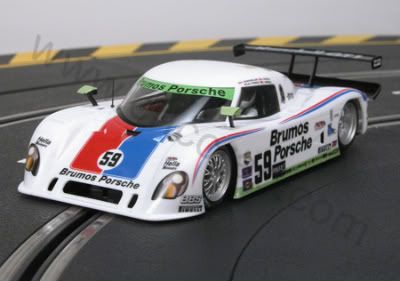
New Fly Slot cars... Brumos DP!


Fly Slot Cars Brumos Porsche DP on Criccrac.com

... I'm wondering how long it will be before Sideways announces this car as well...

Sunday, June 1, 2008

All Fuched Up: BWA Porsche Wheel Inserts

As any of you who have seen my slot car collection or visited my Rennsport Reunion III Gallery can tell you: I like my Porsches. We've had the good fortune to have many models of these great German cars released as slot cars. The problem with many of these Porsche models is a problem that's common across the whole range of slot car manufacturers: wobbly eccentric wheels and bent axles.

If you're looking to upgrade the Porsches in your colletion then BWA Wheels are one likely source for replacement parts. These wheels come in different sizes and allow the slot car racing hobbyist to replace wheels from the narrowest ones used on vintage cars, to the monster rubber used on racing prototypes. What we haven't always had access to are the inserts necessary to finish off these great aftermarket wheels - until now.

BWA has augmented their range of inserts which has up until now included vintage Porsche steel wheel style inserts as well as 5 spoke alloy wheel style inserts with the Fuchs alloy inserts first used on the Porsche 911 model both for street and track use. All of these inserts fit the 32002, 32004, and 32006 wheels from BWA. With a bit of sanding and paint they look great and really finish off the look of any Porsche model slot cars as well as enhance their performance. The steel type wheels are great for Porsche 356, 904, 906, 550 spyder and other vintage machinery. The Fuchs inserts look great on the 911 series cars and have also been used on 904 and 356 series cars. The five spoke alloy inserts look great on 908s, 917s and the Carrera 911 RSR pictured. Between these three inserts just about the whole model range of older cars are covered. The BWA wheels and inserts are available from better slot car parts retailers as well as from BWA directly.

Tuesday, July 24, 2007

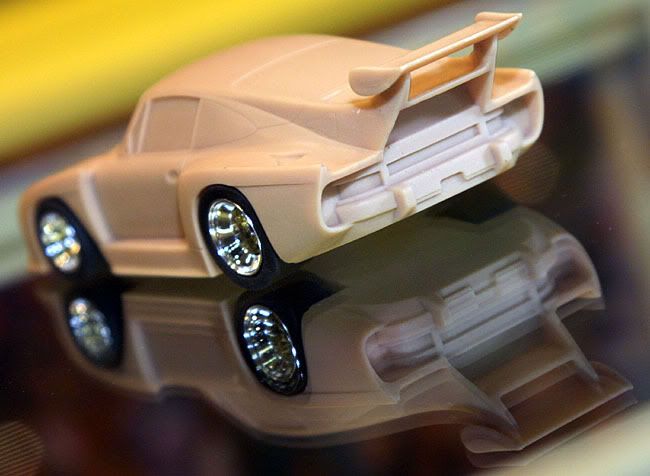
Fly 935 delay


I've heard that it's possible the Fly 935 will be delayed until September.... I can wait. I'm sure I'm not the only one that has high expectations for Fly for this slot car.

DK

Sunday, June 10, 2007

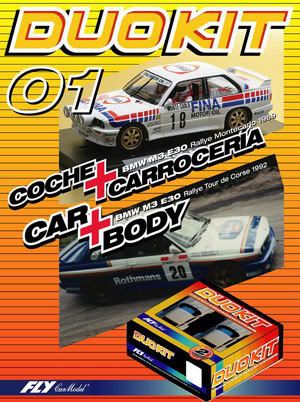
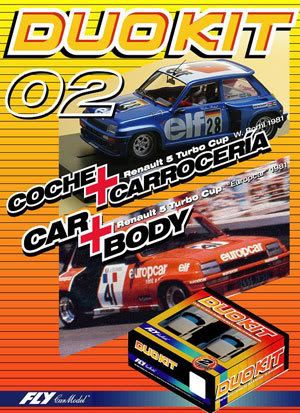
New Fly DuoKits

Well Fly seems to be on the right track with these recent releases of kits, and to add to that they're now going to produce Duo Packs.

From the MRE website:

F-88298 BMW M3 twin-pack-The Fly twin-pack models are a complete car with 2 bodyshells for less than the price of a normal Fly car! Choose to race either the Fina or Rothmans versions, both bodyshells are included in this twin-pack.

F-88300 Renault 5 Turbo twin-pack-The Fly twin-pack models are a complete car with 2 bodyshells for less than the price of a normal Fly car ! Choose to race either the Elf or Europcar versions, both bodyshells are included in this twin-pack.

Friday, June 1, 2007

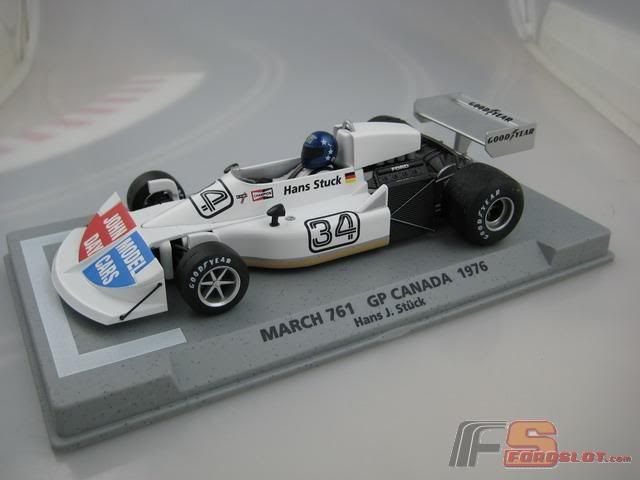
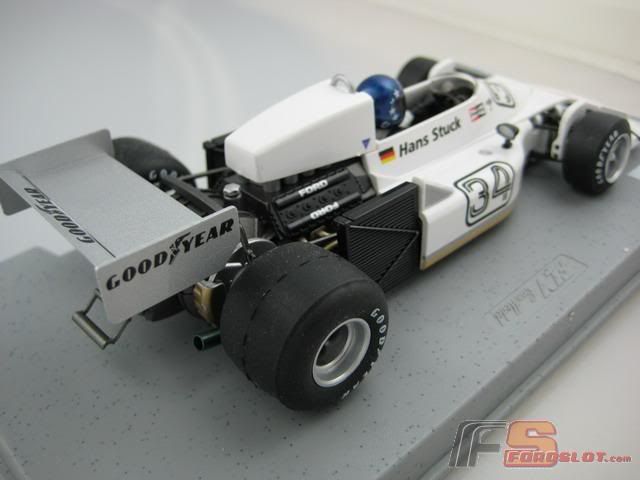
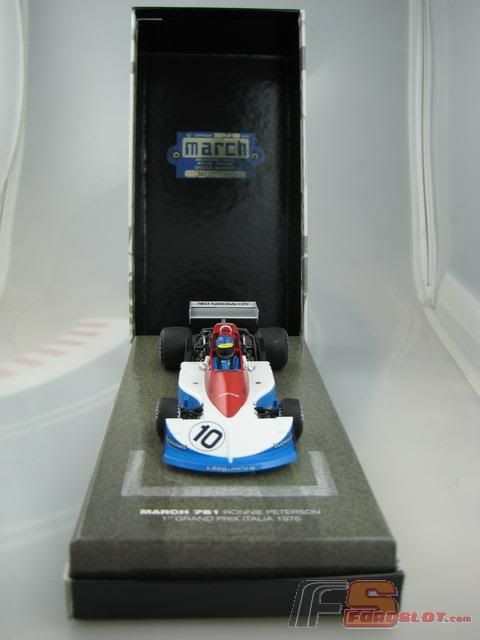
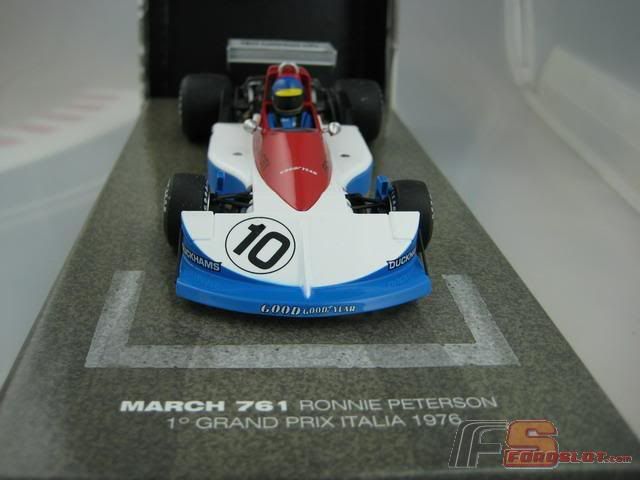
Fly March's on...photos both new March liveries

I'm thinking that Fly has hit on a market that hasn't been done yet. I think these will be a huge hit.


Thanks to Fly and Foroslot for the photos.
DaveK

Tuesday, May 22, 2007

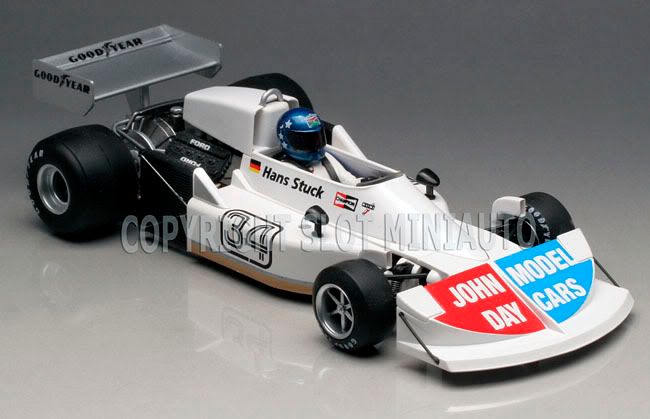
Fly March photo from Slot MiniAuto


Albert Boet, Director of Slot MiniAuto has sent a surprise to SCNews...this is one of the first photos I have seen of the new Fly March. Wow, it sure looks like a great little model.
Thanks to Albert for the photo!

DaveK

Tuesday, October 3, 2006

Fly Racing 911


The Fly Racing Rally 911 is a car destined to be a heavily raced slot car, especially for club and proxy racing. The body is thinner than the regular production Fly 911's.

Fly has done a great job modeling this car. The body seems to be in great proportion and in this version Fly have chosen to do the "ducktail" car first for the Racing version. The overall quality of this car is very good. There is no flash on the body, the wheels are very nicely done. They're plastic BTW, even though Fly calls them Strontium...
The tires and wheels on my version were concentric, and everything you could want in your ready to run car. The Oz Racing type of wheels on this vintage car is odd and I'd prefer the Fuchs wheels, lace BBS style, or Mini-lights wheels on the regular production 911/934's.

I'm not sure if Fly has done this on other Racing versions but on this 911 they've made the wheels removable and the 2.5mm axles have a flat spot on the end so that if you remove the wheels, you can push them back on again and THEY STAY PUT! This is great and this is something that every company should do if they put plastic wheels on cars.

"But... Dave", you say, "why did you remove the wheels if they were so good?" Well, 2 reasons:
1. The front wheels stuck out of the body and tiny bit, but they also would hit the wheel arch while cornering and slowed the car down.
And 2. and most importantly.... look at what happened less than a dozen laps into testing...

The 27-tooth stock crown gear totally disintegrated! At least half the teeth on the gear just broke off...very disappointing. The teeth on the 9-tooth stock pinion were fine.

Back to the rest of the car...

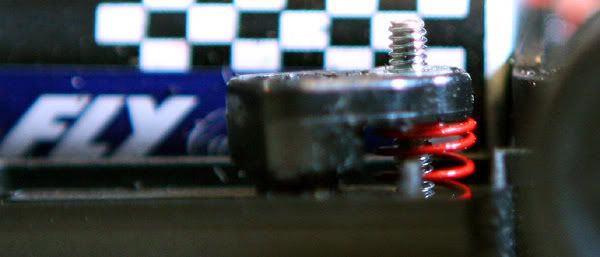
The chassis has a spring loaded motor pod that's adjustable by screwing 2 screws on the sides. This adjusts ride height. The car is equipped with red springs.


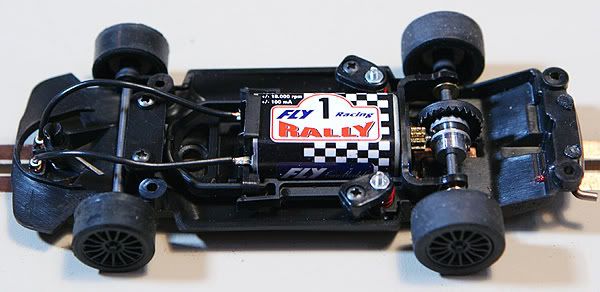
If you flip the chassis over you can see the new Rally 18k motor. The box says this motor is 22,000 rpm at 14.8 volts, but the motor says 18,000 rpm at 14 volts...odd to say the least.

The NC style, short-can motor is held firmly in place by this bracket that covers the nose of the motor.

So since this is a Racing edition of the 911 you'd hope that the parts are suitably thin, thus saving as much weight as possible...well how's this for thin?

The interior is paper thin plastic. And is so thin you can see through it even without holding it up to a light as I've done here. The glass is vacuum formed and exceedingly well done too.

At first my car ran well and very quietly for a few "get to know you" quickie laps on my small wood track. I did maybe 10 laps before heading out to work one day. And then I took the car to the East New York Raceway for serious testing. I got to do only 5 timed laps before the gears let go. In preparation for this possibility I brought some Slot It gears with me. I replaced the whole rear running gear with a Slot It axle, wheels, and Ortmann tires. The stock "Type D" tires worked very, very well on my wood track, but in the very low humidity of the ENYR the only tires that work well enough to get low lap times are the Ortmann's. But on plastic track the stock tires would work well and shouldn't have to be replaced. Another feature this car comes with is a small wrench for changing the gears! I applaud Fly for providing this standard on this model.

The car is well balanced and can be thrown around the track with abandon. It's relatively slow turning motor is an excellent choice for this car. This car is an excellent starting place for a serious racer, but because of the need to replace the gears, I would not suggest this model for the novice racer or first time buyer.

Well, I'm very, very grateful that Fly sent this car for me to test... many tests require that you look at the car from a box stock perspective. This car, being a Racing version, should be held to a higher standard. Especially since the retail price of these cars is somewhat higher than the average slot car. Many things are very right with this car, but the gears have to be addressed in my opinion.

Some numbers:
Body weight stock=82 grams

Speed on ENYR:
Stock tires around 6.9 seconds
ProSlot rubber tires also around 6.9 seconds
Jel Claws tires (after around 300 laps, tires sticky) 5.513 seconds
Ortmann tires for Fly classic hubs 5.35 seconds

Testing notes:
-Needs a bit of weight up front to hold down the sprung guide.

DaveK
Publisher, Slot Car News

Saturday, August 19, 2006

JGTC 13 Slot Car Showdown

The guys that I race with had a JGTC race earlier this summer. The rules called for a stock car that had to be listed on the IMCA JGTC web site.

I decided to bust open my race cases and test all the different examples of JCTCs that I could find. I tested the cars without magnet on the 24m Scalextric Sport test track. The track was a replica of Reckless Racer's "The Coffin" circuit. The infield is very technical, and there's a nice long straight where these cars could wind out to terminal velocity.

What follows is a ranking of the JGTC cars in my collection from slowest to fastest in terms of lap time on the test track. Many of these cars are eligible for GT class entry in the Race Across America. My hope is to provide racers with a basis for comparison when choosing a JGTC or modern GT racer for club or proxy competition.

13. Pro-Slot Porsche 911-GT2 - DNS

Thirteen is Pro-Slot's (un)lucky number. The motor pinion started spinning on the motor's shaft once I was ready to run timed laps for this test. When the car did run, the motor seemed very NC1-ish in terms of grunt. The tires seemed decent enough too. The motor pod chassis design seems to have potential. This car is simply not a runner out of the box. It's a pity as it masks the potential that exists in this car. As you'll see though, there's some pretty hot stuff that works great off the rack...

12. SCX Ferrari 550 - 12.29s

I've really come to enjoy SCX releases. In stock trim, this is a great car for kids to race. Decent adjustable magnetic downforce with working headlights and tail lights. For the smore serious racer the chassis features a rocking motor pod. The SCX bodies are fairly light as well. Where this car falls short is in the horsepower department. If SCX starts putting more grunt in their cars, they will be a brand to watch out for. As it is, a Slot.it motor adaptor and your favourite S-can will transform this car. In stock trim it lacked serious grunt down the test track's long straightaway.

11. Scalextric Porsche 911 GT3 - 11.36s

This car featured the older style chassis with the blue clip-on guide. A smooth runner, but lacking in both grip with stock tires and horsepower. Still, almost a second a lap faster than the Ferrari, and lots tuning opportunities to be found in its sidewinder chassis. Working headlights, as always, are a nice touch.

10. AutoArt Porsche 911 GT3 - 11.29s

AutoArt is one of the brands that doesn't seem to get much recognition. This car (with working headlights!) was a smooth runner out of the box. It featured a sidewinder chassis, and among the skinniest tires in this comparison. The tires were a little loose on the rim, and wrap further around the back of the rim than the front. This should make for a challenge when seeking aftermarket tires for this car. Still, a decent handling sidewinder car. The body on this model would certainly be easy enough to relivery.

9. Cartrix Honda NSX - 11.21s

I bought this car on a whim. It was sitting at my local slot shop and had the Cartrix TX5 boxer motor in it. We tend to race a lot of stock classes at Raceworld Canada, so a stock car with a 22.5k motor is hard to overlook. While this car was a monster on the long straights of my test track, it was average in terms of handling in the more technical sections. Replacing tires and detailing the chassis and drivetrain would buy a lot of time here. Getting the power to the plastic pavement is the problem here.

8. Scalextric Nissan 350Z - 10.76s

This is one of the Takara chassis cars with the digital chip pod. The pod looks like a great place to mess around with weight placement. A smooth runner out of the box as one has come to expect from Scalextric. The brakes on this car didn't seem as good as what is usual for Scalextric. A race tuned version of this car was tied for second in terms of manufacturer points in our JGTC event. Slot.it has what it takes to move any of the Scalextric cars in this test up in the standings: a beefier new motor with more revs, and a decent screw-in wood track guide if you are inclined to replace the stock guide setup.

7. Fly Corvette C5 - 10.65s

I split up a box set to get this car. It is a Ron Fellows Corvette from the Fly Le Mans Team set. Mr. Fellows is a Canadian driver, which is one of the categories of cars that I try to collect.

The Fly C5 Corvettes are really good looking models. Lots of great detail on this model. Prior to running this car I glued in the motor with hot glue. I also ran a bead of hot glue on the driveshaft and rear axle bushings. Personally, I like the balance of a well set up from engined cars. The Scalextric L-88 Corvette being one of my faves in this regard...but I digress. This car ran well with the basic mods I outlined. Tuning in the area of the front axles to reduce play and rear tires and weight to increase traction would yield results at the track.

6. Scalextric Nissan Skyline - 10.52s

One of the more interesting aspects of this road test has been the comparison among different chassis setups between the same manufacturer. Here is Scalextric's interpretation of a JGTC sidewinder chassis. No digital pod, and no indentation on the plinth for you-know-who. I'll take a couple tenths out of the box over the Takara 350Z - thank you very much. A nice smooth runner, but like it's Scalextric siblings suffered in the horsepower arena when compared to the fastest JGTC competitors.

5. Scalextric Porsche 911 GT3 - 10.48s

Who says you can't teach an old dog new tricks? Scalextric updates the Porsche 911 GT2 chassis with the black round guide as opposed to the snap in blue guide flag. This car was .9s faster than it's blue guide-flagged predecessor. Punchy off the line and a smooth handler in the curves made this an easy car to drive at the limit. Plenty of guide rotation on the round black guide probably helped lower the lap times of this chassis design. An exclusive hotter-motored version of this car will be released as a set-car only. This would be an interesting contender in a modern GT contest.

4. NINCO McLaren F1GTR - 10.48s

This is probably one of the first ten slot cars that I purchased. I was never that impressed with it when I was magnet racing. Now that I race without magnets (unless rules stipulate their presence) I have a whole new appreciation for this car. It has an NC2 can in it. I glued in the motor and rear axle bushings on this car. I find that with the NINCO inline cars that this is a necessity. The chassis of NINCO cars are generally quite flexible. This can sometimes work to a racer's advantage, and sometimes be a liability, especially in the are of the crown gear, rear motor mount, and rear axle bushings. Consequently, NINCO cars can sound a little rough in stock trim. Glued and trued, they're nice and smooth. This car is an excellent platform if you want to experiment with boxer motors.

3. McLaren F1GTR - 10.41s

The Jacadi McLaren is exactly the same as the Fina car except for the NC5 rather than NC2 boxer motor. The difference between the two motors being more revs and more torque. This translates to 7/100 ths of a second over its NC2 powered counterpart. Go figure. Still, a great car to race. The stock tires on all the NINCO cars are great right out of the box. This will save someone wanting to race this car a few bucks by letting them do so straight off the plinth. Another great runner.

2. NINCO Porsche 911GT2 - 9.96s

This car features an inline drivetrain with the venerable NC2 motor. The NINCO boxers are the big-block motors of the stock car world. Not big on the rpms, but plenty of torque. Once the motor was glued in on this car any trace of the dreaded NINCO hop was gone. The car settled down and was a fast and smooth runner. All the NINCO boxer inlines were very well behaved at the limit. A decent stock guide allowed a racer to really push the NINCO cars.

1. NINCO Honda NSX - 9.32s

By now I'm sure you have figured out why I did not publish my JGTC findings prior to the BFOS race. This car had .6s in hand over the closest competition. Only Reckless Racer's NINCO Mosler could best it during our race. And even then, it was a close fight when we raced those two cars together at The Coffin.

In stock trim I found the car overmagged, and the motor ran very hot on my Sport setup after a while. The NINCO boxer motors seem to stand up best to the rigors of a hot running car.

Ditching the magnets on NINCO cars gave me a whole new appreciation for them as a slot car manufacturer. Their generally handle very well in stock form without magnets. NINCO Classics are among my favourite no-mag cars, so this observation should have come as no surprise to me.

The NINCO NSX is a car that would benefit from stiffening in the motor/crown/rear axle area. The anglewinder setup is the hot ticket with this setup. I had a blast pushing the NSX to the absolute limit in testing and at the race. So did the other drivers who ran it during our BFOS tournament, bringing it to a tie for second. The tie was with my buddy Triggerhappy's Scalextric Nissan 350Z.

To settle the tie for second we had a race-off. The NINCO NSX romped away from the Scalextric 350Z. The extra NC grunt launching it out of corners, and decent stock guide keeping the car in the slot through technical sections. All this on stock tires! This car can only get faster with further tuning.

I was thrilled to show up at the BFOS race, and come in second in the constructor's points with what is basically a stock car. If only I could say the same for my driving skills. Kudos to NINCO for being the fastest JGTC in this test and getting me onto the constructor's podium for the BFOS race.