Tuesday, February 20, 2007

Spirit S3X Motor


Here is what the Spirit website says about the new S3X long can motor which is in their newest cars:

"REF.00104 MOTOR SPIRIT S 3X Faster. Better Braking.
Stronger magnet effect
Specifications: 24.000RPM. / 12v
13,10 g.-cm magnetic force"

Ok, what does this mean? I assume the 13,10 "g.-cm" is an error, and they meant to say the motor produces 13.1 grams of magnetic downforce when placed at Spirit chassis height over Scalextric or other rails. This does not appear to be a torque rating, which would be in units of g-cm (a European decimal point is a comma, and a comma is a decimal point, in English). Several tests of other maker's long can motors with a Magnet Marshal show downforce readings of about 13 grams.

So that leaves us with the claim of 24k at 12 volts for the RPM rating.

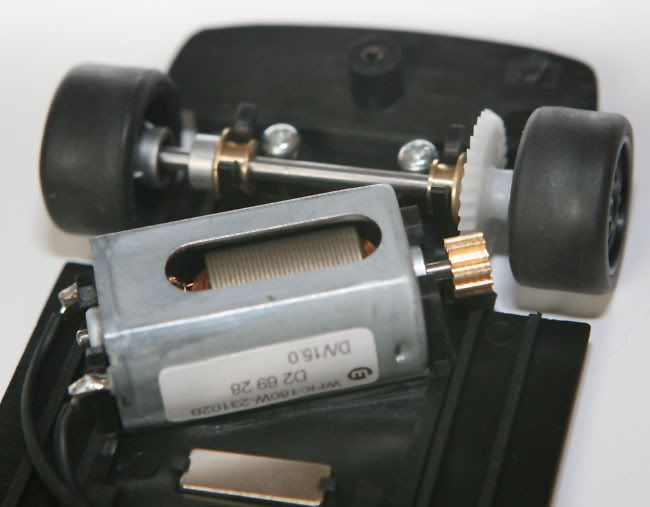
Slot Car News tested two sample S3X motors; one had the colorful wrapper proclaiming "S3X", while the other is in the photo above; plain metal finish with a white label, reading "FK-180" and "D/V 15.0", among other things. My hunch was the motor was rated 24k at 15 volts, not 12v as claimed.

Under the light of the tachometer, both motors spun up at 12 volts, no load, to nearly the same RPM: 19,725 RPM for one, and 19,814 RPM for the other. I adjusted the voltage upward to 15 for the faster motor, and measured 26,163 RPM.

By extrapolating the numbers, 19.8k RPM (15v/12v)=24.8k RPM estimated at 15 volts; right on the claimed rating for RPM, but at 15 volts. This agrees with both the label on the motor and approximate performance of the motor.

Therefore, the Spirit S3X is correctly represented as a 24k (up to 26k) motor at 15 volts, and correctly rated at some 19.8k at 12 volts. The torque is unknown. The label on the motor is correct; the info on the Spirit website is incorrect.

Tuning


Tuning, originally uploaded by jarapet.

http://www.elmundo.es/elmundomotor/2007/02/20/ocio/1171976163.html

Drifting


Drifting, originally uploaded by jarapet.

http://www.elmundo.es/elmundomotor/2007/02/20/ocio/1171976163.html

Volvo C30


L1040286.JPG, originally uploaded by sweatervest_lk.

Monday, February 19, 2007

Diecast slot car


This is an experiment to see how a diecast body would work as a slot car. I used a Porsche 550A Spyder by Maisto, 1/32 scale, installed on an existing chassis. The chassis formerly had a plastic Porsche 356 coupe body, built to compete with Ninco Classics. Performance was competitive as a coupe; lap times were in the range of 6.1 to 6.4 sec.

After the conversion to Spyder, best lap time rose to 6.511, which is understandable, as the overall car weight went from about 88 grams to 140 grams. The die cast body weighs 74 grams, and the plastic body it replaced weighs 22 grams. Chassis is ~65 grams without a body.

The motor is an old Revell SP-500, the first of the FT-16 type slot car motors, from 1964. It is a mild motor, about the same power as an NC-1. Gears are 4:1, unchanged for this experiment. Tires are EJ's rubber, about like Ninco Classic rubber.

The car is a bit slower, but it handles better. Sudden tip-outs plagued this car as a plastic body coupe, but as a metal body spyder, it is more stable. Brakes seem to be the same; maybe a little softer, but not bad. In fact, I think I'll leave it with the 550A Spyder body.

I had been using this diecast Porsche's front wheels and tires all along, thus the good fit. Rears were turned into inserts, and placed inside Revell aluminum wheels from the days of old.

Excellent results from this experiment. The drivability of the car is not compromised; the brakes remain good, the acceleration is slower, the cornering is more stable, and the lap times are about 94% as fast.

Highly recommended!

Robert Livingston, Technical Editor

Lexus at Chicago AutoShow


Chicago2007AutoShow-65, originally uploaded by fiberangel.

Sunday, February 18, 2007

SCX news for February

A spec sheet for the new SEAT Leon SCX livery.


Some new liveries for February that will be available very soon.