Sunday, November 30, 2008

Audi TT-RS headed to Geneva Motor Show

Audi TT-RS

Audi-philes have even more reason to rejoice now that news comes in of an imminent TT-RS launch next March at the Geneva Motor Show. The standard-fare TT offers plenty of punch, and the TT-S spices things up a bit with a high-pressure version of Audi/VW's 2.0L forced-induction four banger. Sometimes, way too much is, ya know... just enough, and for speed freaks, Audi has apparently green-lighted an ultra-hot version as well. The RS will bring the vaunted inline-five engine configuration back under the hood of an Audi, and it's a turbocharged unit derived from the mill that normally sees duty in Jettas and Golfs. If that doesn't sound like a good enough bloodline, think of it as half of Lamborghini's V10. With as much as 340 ponies corraled through a six-speed gearbox and quattro all-wheel drive, expect the TT-RS to be hottest four-ringer this side of an R8.

[Source: Car and Driver]

ABT Scirocco heads to Essen

ABT Scirocco
ABT Scirocco

So, the Essen Motor Show is coming up. For those of you unaware, it's basically a Euro SEMA. All the tuners will be there, showing off stuff that's both decent and dreadful, proving that yes, Europeans can do bad taste as well as anyone this side of the Atlantic. ABT is entirely capable of serving up either dish, but in the case of their Scirocco, they manage to stay on the better side of decent. You know the drill: body kit, wheels, suspension, brakes. They have power upgrades, too -- bumping the wee 1.4 TSI to 200 horses, and the 2.0 TSI to 240. Unfortunately, a look 'round back indicates that this whole stacked-tailpipes thing recently adopted by Lexus and Ferrari is on its way to becoming a fad. We love this shade of green, which looks to be the same as that used on the original VW IROC concept, but ABT's car wins because it doesn't have a face that looks like it was inspired by something on a Pokemon card.

[Source: ABT Sportsline]

Auto Art Jaguar C-Type Le Mans 1953


I think I am in love.

Even after 3 years of heartache while waiting since it was first announced, I am still enamored with this car. I knew it would look good from years of experience with Autoart diecast cars, but some of their previous 1/32 slot cars had been less than impressive from a performance standpoint. I am happy to say that this car meets nearly all of my expectations for a great slot car. Autoart have addressed several problematic designs and produced a surprisingly good driving slot car!

And what better car to build so well, than the gorgeous Jaguar C-Type that won Lemans for the second time in two years in 1953, this time in the hands of Tony Rolt and Duncan Hamilton. It was based on the production XK120 sports, but covered in a lightweight, aerodynamic, and beautiful aluminum body. It was also one of the first racer cars to make successful use of 4 wheel disc brakes, which made up for slightly lower top speed than some other cars. The car was certainly fast because this victory also marked the first time a car had averaged over 100mph for 24 hours, 105.85 mph to be exact.

First let me say that I am not a scale or jaguar expert and I apologize because my photos can not do this car justice. But to my eye, I think Autoart (AA) have nailed this car. The proportions, colors, and stance are just about perfect, again to my eye. It is about the size of the Carrera D-Type, just slightly longer wheelbase and wider track, but much smaller than the Ninco XK120. The overall length is 122mm, the track (outside edge of tread) is 45mm front and 47mm rear, and the wheelbase is 76.5mm. And the details are breathtaking, rivaling their 1/18 scale diecasts. The wheels are stunning with photo etched wire inserts and knock offs mounted with scale narrow tires.

The paint is a very dark, deep green applied perfectly smoothly. There are photo etched grills and latches and the gas cap is very realistic. The tonneau cover is made of rubber, as is the driver! This is a great idea for an open slot car with no roll bar, even run with the magnet, I doubt you’ll be able to lose this driver’s head... The leather straps holding the engine cover on also seem to be molded of rubber. The full depth interior is nicely detailed too. The car also has working lights front and rear! This level of detail on a $45 car is just amazing.

But this cars beauty is more than skin deep. In order to have the full interior this car is a front motor design. While they are almost never the fastest, I really enjoy the handling of a front motored car, especially with no magnet if set up correctly. They seem to be more forgiving and easier to drift smoothly. The motor is connected to the driveshaft with the standard spring, but the driveshaft rides in a brass bushing like the axles for all 4 wheels. The gears are the standard AA 10/28 plastic pinion and crown, but run very smoothly from the start. The front axles are independent stubs, but they are metal ones riding in brass bushings and with virtually no play at all!? Until I removed the body, I though it had a solid front axle!

The guide is relatively solid and sits almost perfectly deep in the slot with the front tires just touching the track! No adjustments needed and it is the standard style with wires attaching directly into the braids. The chassis is also nice and straight with all 4 wheels touching evenly. The lighting wires have a quick release plug for disconnecting the body from the chassis when it is removed. There is a single bar magnet glued into a slot on the bottom of the chassis about halfway between the motor and rear axle. The magnet can be removed by pushing through slots from the top of the chassis, which I did later because like rally cars, vintage sports cars shouldn’t have magnets.


The magnet is not too powerful when first run on my Scaley Sport track and the motor has good response, and brakes!? It must be new because previous AA motors seemed to lack torque, especially with magnets, and braking. It seems closer to the standard Mabuchi motor used by Scalextric power and brake wise. The car was very quick, but would slide fairly predictably without crashing. It was also quiet and smooth running, but the brass bushings need a little oil and some grease for the gears. Although the car ran very well with magnetic down force, I was scared to crash my new prize, so I soon removed the magnet to see how bad it could be? To my pleasant surprise, it was drivable with just the magnet removed on stock tires! On the stock 16v power, I had to be very gentle with the throttle, but it could be smoothly run around! And it could be pushed to drifting without crashing if done with care. It seemed to have potential!

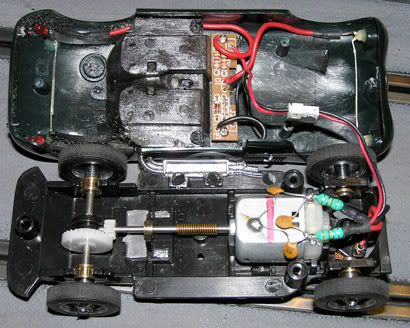
A little tuning seemed to be needed, but just a little. Most front engine cars respond well to weight added near the back to bring them to at least a slight rear weight bias, which seems to work well with slot cars. I added about 6-7 gms. of lead in the stock magnet pocket and above the chassis right behind the magnet pocket, just ahead of the rear axle, as seen in the photos. The only other tuning done was a pair of Tru Grip tires for Scalextric Cooper F1 cars on the rear. Other narrow vintage tires should also fit. The wheels were also cleaned up to remove a little flashing on the ribs, but they seem pretty true. I did have to trim the inner rear wheel wells inside the body (also seen in the photos) to clear the new tires, although they are just slightly larger than the originals.

With these few easy changes, the car improved greatly. It is now quicker, but also very easy to push hard, drifting smoothly out of turns just like they did for 24 hours back in the day. It can be driven deep into the corners using the strong brakes (just like the real thing!) and while it will just tip at the limit, it is pretty easy to feel the edge. Though the power is a bit strong for this vintage on this voltage, this new motor is much easier to control than the old AA lump. It is just a really fun car to drive now. And the wonderful combination of a beautifully scaled and detailed model that runs so well is just what this hobby is all about. I spent hours in the basement last night just sliding it around my track with a smile on my face. And for the price of this model, I think Autoart has raised the bar for value in vintage slot cars.

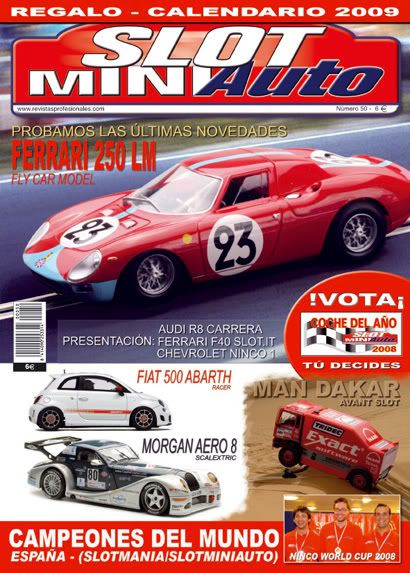
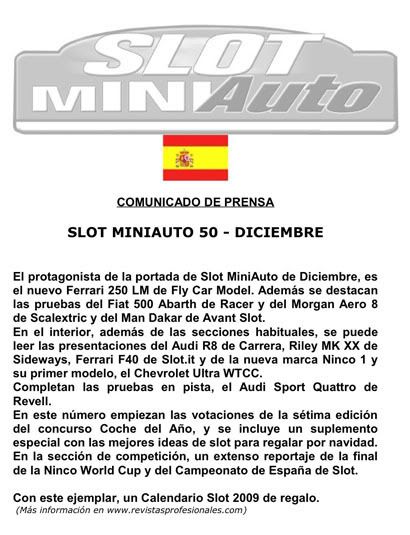
Slot MiniAuo #50


Saturday, November 29, 2008

Official photos of the SCX Compact Porsche

Official photos of the SCX Compact (1/43 scale) Porsche 911 (997) Cup car. They will be released first in the GT Overtake set then as individual releases in 2009.


Volkswagen

Wolfsburg, 19 September 2008 - Forty years have passed since Volkswagen presented the VW 411, at that time the company’s largest and most powerful model yet, to some 200 journalists in Wolfsburg. The journalists had earlier put the VW 411 through its paces on the new Volkswagen proving ground in Ehra-Lessien, testing the vehicle’s equipment and performance. Volkswagen built 367,728 units until production ceased in July 1974, and 416 of these are currently registered as old-timers.

The ads claimed there had never been a VW like this before. And they were quite right. This was the very first model with a unibody, a four-door option, more space than any other Volkswagen and a longer wheelbase than the Beetle. A newly-designed, powerful, 68 bhp air-cooled 1.6 liter boxer engine mounted in the rear of the VW 411 was robust enough even for long journeys at a maximum speed of 145 km/h. The innovative sporty chassis with MacPherson strut front suspension and rear suspension with double joint axles also used in the Porsche 911 made sure the car held the road well. The midsize saloon featured “the luxury of a luxury car”. Available with either a Normal or an L equipment line, “Wolfsburg’s biggie” offered customers space and ride comfort, enhanced safety, a total 570 liters of luggage space in front and rear and an optional automatic transmission.

The history of what was known as the Type 4 began in 1962 as development project EA 142. The economics of series production, which began in February 1967, were based on the sale of 822,500 vehicles over a four year period with daily production of 1,000 units. The price of the VW 411 ranged from 7,770 to 9,285 DM.

Compared to the VW 1500/1600 launched in 1961, the VW 411 was noticeably larger and better equipped. Volkswagen aimed to establish the new vehicle in the upper midsize segment which was beyond the reach of the Beetle and the Type 3, and to expand the market position in the long term by broadening the model range. For this reason, the publicity concentrated on technical innovations and the high level of comfort as well as highlighting typical Volkswagen characteristics such as quality, economic efficiency and service.

In the run-up to the market launch on October 5, 1968, dealers, the press and customers responded positively to the VW 411. Once the car had come to market, problems with the clutch on the first models delivered and an increasingly negative press curbed sales prospects. The most common complaints from customers related to engine and driving noise, the engine’s limited output and what was perceived as an unaesthetic front end. Since over 80% of VW 411 buyers were already Volkswagen customers, the vehicle failed to win new customer groups. As a result of these marketing problems, which could not be remedied by sales incentives either, Volkswagen sporadically lowered production to 75 vehicles per day.

The company introduced an improved version, the VW 411 E, for the 1970 model year. Electronic fuel injection boosted engine output to 80 bhp and the front end, which had given the model the nickname of “Nasenbär” (coati), received a facelift. The VW 411 E Variant, provided even more space for luggage, and this estate version was soon selling twice as well as the hatchback saloon. Type 4 exports to the USA began in 1971, and the car sold better than expected there, soon accounting for roughly 40% of total sales. A further new and improved model called the VW 412 followed in 1972. Production of the Type 4 at the Wolfsburg plant continued until 1973, when the production line was relocated to Salzgitter, and production at Volkswagen of South Africa commenced in 1969.

Even though the VW 411/412 did not break any sales records, the model nevertheless has an important role to play in Volkswagen’s automobile history as the last large series model with air cooling and a rear-mounted engine. A 1966 prototype is on display at the Automuseum Wolfsburg. The Type 4 has by no means been forgotten. Type 4 fan clubs in Germany and abroad have been presenting their lovingly preserved automotive rarities at a stand at Techno Classica since 2005.

Source: Volkswagen Press Release

Friday, November 28, 2008

Ferrari FXX photos

Photos of the new Ferrari FXX by SCX.